
Monday, September 26, 2011


Friday, September 23, 2011
Three more memorials
Yesterday I visit the memorials at Te Kuiti, Pio Pio and Awakino today on my way back up North I will take a look at Otorohanga.
The Great Adventure often started at home...
Whilst driving through the King Country yesterday from Te Kuiti to Awakino (on the west coast) it struck me that for many New Zealand young men their great adventure began at home.
The journey from Te Kuiti to Awakino is a great drive, a smooth road, winding but not unmanageable and the King Country scenery was spectacular. My journey was also comfortable and relatively short compared to those young men who volunteered for service in World War One Then the journey from rural New Zealand to the big cities of Auckland and Wellington was in itself a great adventure. Many who volunteered from places such as Awakino had never ventured far from the area they came from and had certainly not been to the city.
The initial few months in New Zealand and aboard troop ships en route to the war were as we now know the great adventure. The so called great adventure of World War One turned out to be a nightmare for most. New Zealand soldiers in their revolting trenches I am sure lamented the time when they had thought this would be their great adventure.
The journey from Te Kuiti to Awakino is a great drive, a smooth road, winding but not unmanageable and the King Country scenery was spectacular. My journey was also comfortable and relatively short compared to those young men who volunteered for service in World War One Then the journey from rural New Zealand to the big cities of Auckland and Wellington was in itself a great adventure. Many who volunteered from places such as Awakino had never ventured far from the area they came from and had certainly not been to the city.
The initial few months in New Zealand and aboard troop ships en route to the war were as we now know the great adventure. The so called great adventure of World War One turned out to be a nightmare for most. New Zealand soldiers in their revolting trenches I am sure lamented the time when they had thought this would be their great adventure.
Wednesday, September 21, 2011
What's happening next...
Tomorrow I am off to the King Country for a flying visit and to visit several memorials. Just purchased the republished 'Maori in the Great War' by James Cowan. The book was first published in 1926 and has been republished by Willson Scott Publishing. Great to have a list of all those who served in the Maori/Pioneer Battalion.
The Gaskell Brothers - Ngaruawahia Memorial
Four sons of Arthur Herbert and Edith Gaskell of Glen Murray, Waikato served during World War One a worthy contribution from any single family. The first to enlist was George Oscar Gaskell on 10 August 1915. He served with the Field Ambulance Corp and received multiple injuries on 1 October 1916 and according to his records he never went back to the Front staying in the UK in convalescent camps were he also worked as a dispensary (before becoming a farmer he had been a chemist). He was discharged from service on 22 May 1919.
Frederick Arthur Gaskell was the second brother to enlist on 5 October 1916. He embarked with the New Zealand Rifle Brigade (NZRB) on 16 February 1917 aboard the Navua departing from Wellington. During his service he rose to the rank of Sergeant. On 15 May 1918, Frederick Gaskell received a Distinguished Conduct Medal for his efforts - London Gazette entry below:
For conspicuous gallantry and devotion to duty after assuming command of a platoon. He organised his under heavy fire, pressed his attack home, and helped to capture an enemy strong position. He sent back useful information to adjoining troops, and generally displayed initiative and good leadership.

On 26 August 1918 during the Battle of Bapaume he received a gun shot wound to the abdomen and died on 28 August 1918. He was buried at Bagneux British Cemetery, Gezaincourt, France.
Norman Gaskell was the next to enlist on 30 April 1917 and embarked on 13 August 1917 aboard the Mokoia from Wellington with the 29th Reinforcements, E Company. He marched into Etaples Camp in France on 29 October 1917 and was attached to the Wellington Infantry Regiment on 8 December 1917. Then on the 6 February 1918 he was admitted to hospital sick. He remained in hospital for the duration of the war initially with influenza which turned into Bronco Pneumonia. On the 11 November 1918 the day the war finally ended Norman Gaskell died. He was buried in Brookwood Military Hospital, England. Norman was only 22 years old.
The last of the Gaskell brothers to enlist was Percy Gaskell on 20 September 1917 he embarked on 29th Reinforcements E Company aboard the Athenic from Wellington. He joined 2nd Battalion, Auckland Infantry Regiment in the field on 29 June 1918. However, Percy spent most of his war until discharge in and out of hospital with sickness. He was discharge on 5 August 1919 after returning to New Zealand.
Frederick Arthur Gaskell was the second brother to enlist on 5 October 1916. He embarked with the New Zealand Rifle Brigade (NZRB) on 16 February 1917 aboard the Navua departing from Wellington. During his service he rose to the rank of Sergeant. On 15 May 1918, Frederick Gaskell received a Distinguished Conduct Medal for his efforts - London Gazette entry below:
For conspicuous gallantry and devotion to duty after assuming command of a platoon. He organised his under heavy fire, pressed his attack home, and helped to capture an enemy strong position. He sent back useful information to adjoining troops, and generally displayed initiative and good leadership.

Although considered to be the army's second ranking gallantry award, the DCM was almost always seen as a "near miss for the VC".
On 26 August 1918 during the Battle of Bapaume he received a gun shot wound to the abdomen and died on 28 August 1918. He was buried at Bagneux British Cemetery, Gezaincourt, France.
Norman Gaskell was the next to enlist on 30 April 1917 and embarked on 13 August 1917 aboard the Mokoia from Wellington with the 29th Reinforcements, E Company. He marched into Etaples Camp in France on 29 October 1917 and was attached to the Wellington Infantry Regiment on 8 December 1917. Then on the 6 February 1918 he was admitted to hospital sick. He remained in hospital for the duration of the war initially with influenza which turned into Bronco Pneumonia. On the 11 November 1918 the day the war finally ended Norman Gaskell died. He was buried in Brookwood Military Hospital, England. Norman was only 22 years old.
The last of the Gaskell brothers to enlist was Percy Gaskell on 20 September 1917 he embarked on 29th Reinforcements E Company aboard the Athenic from Wellington. He joined 2nd Battalion, Auckland Infantry Regiment in the field on 29 June 1918. However, Percy spent most of his war until discharge in and out of hospital with sickness. He was discharge on 5 August 1919 after returning to New Zealand.
The Bell Brothers - Ngaruawahia Memorial


John Edward Bell and Alexander Law Bell were brother's and the only two sons (that I can find) of Edward and Mary Bell of Ngaruawahia. They embarked together on 17 April 1915 from Wellington with the 4th Reinforcements. They had in fact enlisted separately John at Urenui in Taranaki and Alexander at Taupiri in the Waikato.
Both would have served during the Gallipoli Campaign where John Bell was wounded on 4 October 1915. After Gallipoli the next stop would have been France and Belgium. I have not as yet been able to access Alexander Bell's military record however, I assume that at some point he was either wounded or fell sick as he returned to New Zealand sometime during 1917. On his Cenotaph record it is clear he reembarked again with the 32nd Reinforcements, New Zealand Field Artillery (NZFA) on 21 November 1917.
Sadly on 17 June 1917 John Bell was killed in action in Belgium (he too served with the NZFA) he was 27 years old. I expect the death of his brother made Alexander Bell's return to the Front a very poignant one. Alexander himself died of his wounds on 9 August 1918 in France his age at death is recorded as 21 years on his CWGC (Commonwealth Grave Commission) entry. I checked to see when Alexander's birth was registered and it is recorded as 1897 which would mean he was only 17 or 18 years old when he enlisted, he no doubt lied about his age when he enlisted.
The story of brothers not returning is unfortunatley a common one of World War One. On the Ngaruawahia memorial alone there are five sets of brothers recorded who gave their lives.
Tuesday, September 20, 2011
Ngaruawahia war memorial

Ngaruawhia memorial is an impressive memorial, especially as I found a newspaper article suggesting that the memorial had difficulty beginning.
PUBLIC'S APATHETIC ATTITUDE
Thames Star, Volume LIII, Issue 14258, 17 June 1920

It is obvious there was a change of heart and the memorial was unveiled in 1922. I would like to hear more about the memorial origins and I shall continue to dig and delve.
Thursday, September 15, 2011
Sergeant Henry Clarence Welch - Gordonton Memorial

Henry Clarence Welch (known as Tat) enlisted with his brother George Carlton Welch both were the sons of George Edward and Jane Welch of Komakorau. They embarked together on the 5 January 1916 with the New Zealand Rifle Brigade, 4th Battalion, A Company and it is likely they served together on the Somme where George was killed in action on 3 October 1916, he is remembered at the Caterpillar Valley (New Zealand) Memorial, Caterpillar Valley Cemetery, Longueval, Somme, France, he was 21 years old. It is hard not to wonder if his brother Henry was with him when he died.
Henry Welch went on to win a Military Medal when a raid was carried out at midnight on 17 December with the primary aim being the close examination of the enemy's support line as well as his forward trench at a salient known as "Corner Fort." The raid was led by four officers and 182 men of other ranks. According to the New Zealand Rifle Brigade History the raid was a success with only one man being killed and four injured. Sergeant Welch's Citation is below:
London Gazette, 19 February 1917, p1757, Rec No 522: "For gallantry and special good work during the raid by the 4th Battalion, 3rd New Zealand (Rifle) Brigade on the enemy trench at Corner Fort, south of Fleurbaix on the night of the 17th/18th December 1916. Though heavily bombed when he first entered the enemy trenches he led his party with great skill, silencing the party exposed to him, killing a number of them, and finally capturing 5 prisoners."
I am certain George was never far from Henry's mind as he continued to fight on in the war. Sadly, Henry too was killed in action on 10 May 1917 at Messines he was 23 years old and is buried at St Quentin Cabaret Military Cemetery, Heuvelland, West-Vlaanderen, Belgium.
Gordonton Memorial

Gordonton Memorial was unveiled on the 17 October 1918 (before the end of the war), it was unveiled by R.F. Bollard Member of Parliament. The memorial has both those who served and those who fell inscribed.
Wednesday, September 14, 2011
Private Herbert Gadd - Pokeno Memorial

Private Herbert Gadd was born in Birmingham, England on 4 June 1896, he was the son of Herbert and Annie Gadd who later moved to New Zealand. Before he enlisted Private Gadd was a timber worker for the United Timber Company in Mercer. If his birthdate is correct, shortly after turning 20 years old he enlisted for service on 24 July 1916. Private Gadd embarked with the New Zealand Rifle Brigade, 13th Reinforcements 1st Battalion, E Company on 15 November 1916, aboard the Manganui leaving from Wellington bound for Plymouth.
Once in France he joined the 1st Auckland Regiment in April 1917. He most likely served with the Auckland Regiment at Ypres. Private Gadd was granted leave to the UK on 28 February 1918, rejoining his unit on 19 March 1918. Just over a week later after returning from leave he was killed in action on 27 March 1918 at the Somme.
In his military records there is an unofficial report by Private Bertram Ashley that Private Gadd was buried in a shell hole at Mailly Maillet. Private Gadd is remembered at Euston Road Cemetery, Colincamps, 170 of the burials at Euston Road are unidentified but there are special memorials to 32 casualties known or believed to be buried among them, Private Gadd is one of those.
Second Lieutenant Arnold Lorie - Pokeno Memorial

Second Lieutenant Lorie embarked with the Samoan Advance Party on 15 August 1914 he would have been maybe 19 or 20 years old. After returning from Samoa he embarked with the 5th Reinforcements as part of the Auckland Infantry Battalion on 13 June 1915. He served at Gallipoli until the evacuation and once in France served on the Somme and at Messines were he was Mentioned in Despatches for courage and devotion to duty. Citation below:
Citation for Mentioned in Despatches (MID): "For conspicuous courage and devotion to duty. At Messines on the 7th June 1917, he commanded a platoon and successfully established one of the advanced posts. He showed great coolness and resource and sent back very valuable reports. He has previously done excellent work at the Somme and on the Gallipoli Peninsula." (London Gazette, 28 December 1917, p. 13575, Rec. No. 1204)
After the Somme he was sent to Cambridge to study for a commission. He was wounded towards the end of the Battle of Messines and was sent on a short leave to recover before being sent back to the front. Second Lieutenant Lorie was killed in action on 28 December 1917 at Ypres aged 23 years old. Second Lieutenant Lorie is a fine example of a brave young man who (like many) survived some of the memorable campaigns of World War One and whose luck ran out. He gave his all and despite his life being a short one, he contributed greatly to New Zealand which should not be forgotten.

Evening Post, Volume XCV, Issue 13, 15 January 1918, Papers Past, National Library, Wellington
Monday, September 12, 2011
Pokeno Memorial, Waikato

The Pokeno Memorial was unveiled on 25 April 1921 by the Honourable G. J. Anderson the Minister of Labour and Mines. The Memorial also records those who served in WW2
Private Andrew William Meaney - Puhoi Memorial

Private Andrew Meaney embarked with the 25th Reinforcements on the 26 April 1917 attached to the Auckland Infantry Regiment. His war was short as he was killed in action on 22 October 1917 at Ypres.

Private Meaney's brother Anthony Meaney survived the war. Private Andrew Meaney is remembered on the Tyne Cot Memorial.
Thursday, September 8, 2011
Turnwald Family - Puhoi Memorial
Thanks to Jenny at the Puhoi Historical Society I have received information on the Turnwald Family's contribution to World War One.
There is a list of those who served in the Puhoi Hall and on this list there are seven Turnwalds. Four of them including John Francis Turnwald are brothers and three others are cousins. Surely a great contribution to the Great War.
There is a list of those who served in the Puhoi Hall and on this list there are seven Turnwalds. Four of them including John Francis Turnwald are brothers and three others are cousins. Surely a great contribution to the Great War.
Private Lorenz (Larry) Turnwald b. 23 Jul 1884 son of Bartolomaus and Anna (nee Becher) Turnwald
Rifleman Tom Turnwald b. 10 May 1883 son of Bartolomaus and Anna (nee Becher) Turnwald
Trooper John Francis (Jack) Turnwald b. 2 Mar 1894 son of Bartolomaus and Anna (nee Krohn) Turnwald
Private Bennett Turnwald b. 7 Jul 1896 son of Bartolomaus and Anna (nee Krohn) Turnwald
The above four were all brothers.
The three below would be cousins of those above, two of them brothers
Private John Edward Turnwald b. 9 Sep 1893 son of Lorenz and Anna (nee Gauga) Turnwald
Joseph George Turnwald b. 19 Jan 1881 son of Lorenz and Anna (nee Gauga) Turnwald
Joseph John Turnwald b. 13 Jul 1879 son of Joseph and Eva (nee Bayer) Turnwald.
Bartolomaus, Lorenz and Joseph were brothers.
As far as I can ascertain all of the Turnwald's survived the war apart from John Francis Turnwald.
Wednesday, September 7, 2011
John Francis Turnwald - Puhoi Memorial

Trooper John Francis Turnwald was the son of Bartly and Annie Turnwald, of Puhoi. He too like Trooper Parry embarked on the 13 June 1915 with the 5th Reinforcements as part of the Auckland Mounted Rifles. Once in the Middle East however, Trooper Turnwald like several mounted troopers joined the Imperial Camel Corp. The Imperial Camel Corp (ICC) is probably one of the least known units of the First World War which was made up of troops from New Zealand, Australia, India and the United Kingdom. The ICC were not only used in battle but also for the transport of supplies.
To learn more about the ICC or the Cameliers as the men who served in the Corp were know, follow the links below to the NZ History website and the NZ Mounted Rifles (NZMR) website. The NZMR site has some great original photographs of the ICC.
http://www.nzmr.org/support.htm
http://www.nzhistory.net.nz/war/camel-corps/nz-companies
There is also a publication called 'With the Cameliers in Palestine' written by John Robertson who served in the 16th Camel Company (a NZ company). The book was first published in 1938 but has since been republished.
Trooper Turnwald was wounded at El Arish in Egypt and died of his wounds on 6 June 1917 aged 23 years old, he too is buried at Kantara Memorial Cemetery in Egypt.
The Turnwald family sent five members to the Great War and at the time there was some confusion as to if they were all brothers. I can find five listed on the Cenotaph database but they seem as if they were most likely cousins. Below is a newspaper account which reports the confusion, although I am not to sure their conclusion is correct.


Anyone out there know the facts of this story?
William Norman Glyn Parry - Puhoi Memorial

Trooper Parry was the son of John Glyn Parry and Annie Parry of Pukapuka. He embarked on 13 June 1915 with the 5th Reinforcements as part of the Auckland Mounted Rifles.. Before his final departure he came home on leave from the Trentham Camp in Wellington. While on leave he was given a rousing farewell.

Rodney and Otamatea Times, Waitemata and Kaipara Gazette , 28 April 1915, Papers Past, National Library, Wellington
Trooper Parry served at Gallipoli but was killed in action in Egypt on 9 August 1916. He is buried at Kantara War Memorial Cemetery, Egypt.


Papers Past, National Library, Wellington
His brother Ivan/Ivor Parry embarked with the Main Body on 16 October 1914 with the Auckland Infantry Battaltion. I found a report by Parry which recounts his experience in Gallipoli:

Papers Past, National Library, Wellington


Warkworth Memorial
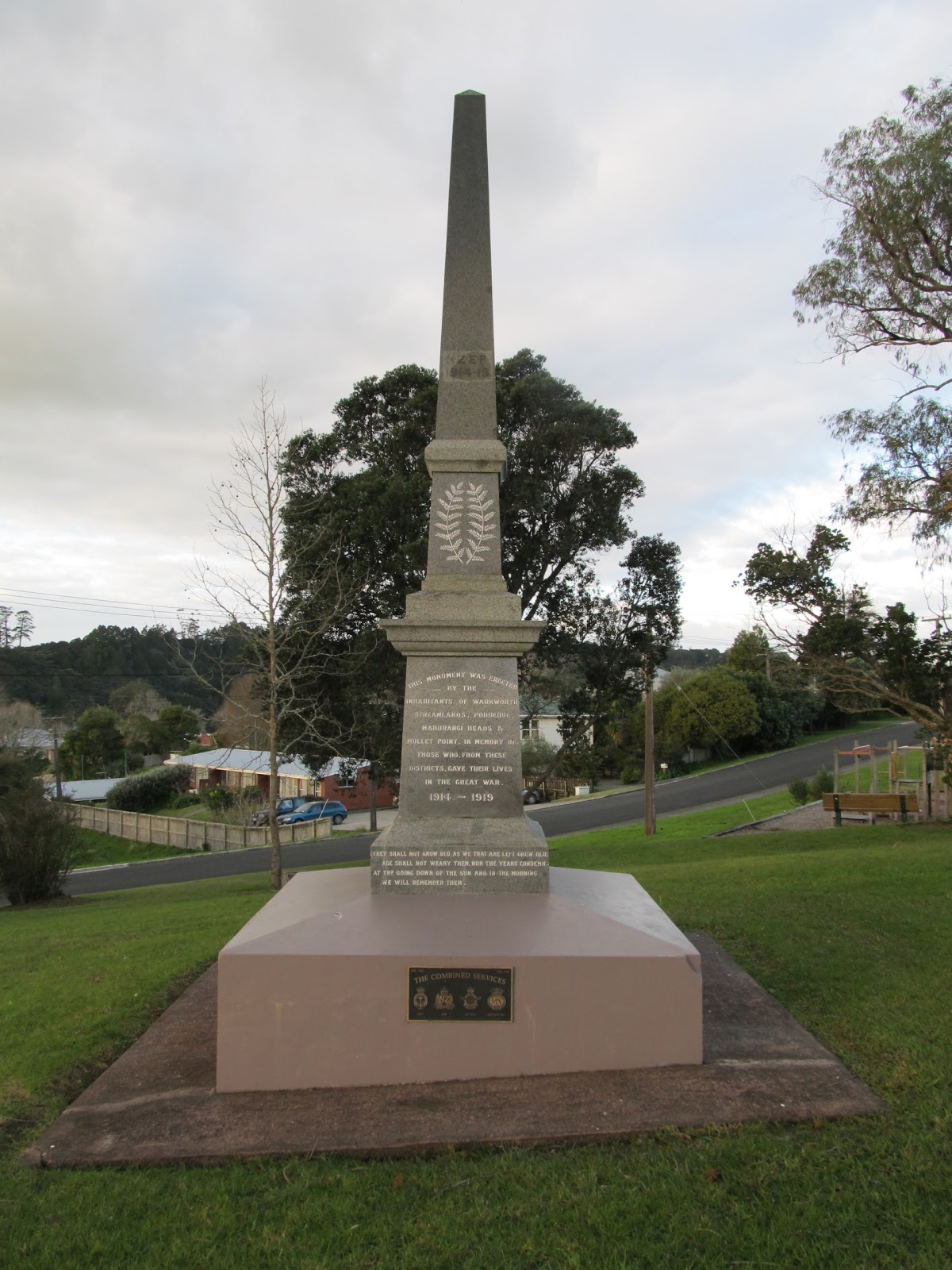
The idea of a memorial at Warkworth was raised early in 1919 by letter to the Rodney County Council suggesting that funds should be raised for the erection of a County memorial in Warkworth to 'our fallen soldiers' of the County. The Rodney County Council suggested the initiative be put to the Warkworth Town Board and the idea of a County memorial did not seem popular.
Finally a meeting was called by the Warkworth Town Board with 13 persons present. A committee was formed from the attendees with the aim of erecting a memorial to the fallen soldiers of Warkworth, Streamlands and surrounding districts. The committee members were:
W. Hamilton - Chairman
H.B. Moore - Secretary
T. Blair
J. Carran
G.T. Civil
A.N. Phillips
G.H. Phillips
It seemed it would be impossible to get an accurate list of those who had served and fallen and as a result it was decided that an all encompassing inscription be sought instead. Suggestions were called for by the committe but were short in coming forward. In the local newspaper the committee printed several suggestions for the inscription so that people could choose the one they preferred. In the end several inscriptions were used.


The Memorial itself was made of Coromandel Granite in a design submitted by Mason & McNab. Despite the stone being ordered in April 1920 the delivery of the stone was delayed and did not arrive until November 1921. In a twist of fate the memorial was erected on 11 November 1921 - Armistice Day and it was thought that this fact should be recorded on the Memorial.

"not so much for us and our children, but that our children's, children might remember what these gallant fellows had done and suffered for us"
The above information was sourced from the Rodney and Otamatea Times, Waitemata and Kaipara Gazette courtesy of Paper Past, National Library, Wellington.
Saturday, September 3, 2011
Private Arthur Francis Miller Shannon - Tomarata Memorial
Private Arthur Shannon was the son of Frank Shannon the Rodney County Engineer. Private Shannon embarked with the 12th Reinforcements on the 6 May 1916 attached to the Wellington Infantry Battalion. He was killed in action on the 24 August 1918 at Baupaume while serving with the Auckland Infantry Battalion aged 24. Below is a letter printed in the Rodney and Otamatea Times, Waitemata and Kaipara Gazette on the 18 December 1918.


Receiving a letter such as the above would have been of great comfort to his family but one 2nd Lieut. Lang would no doubt have found difficult to write. I wonder if the letter still exists today? According to the letter Private Shannon's body was buried '500 yards west of the village' however it is unfortunate that his body was never recovered as Private Shannon is remembered on the Grevillers (NZ) Memorial. The Memorial commemorates almost 450 officers and men of the New Zealand Division who died in the defensive fighting in the area from March to August 1918, and in the Advance to Victory between 8 August and 11 November 1918, and who have no known grave.(from the CWGC website).

Subscribe to:
Posts (Atom)