Tuesday, May 17, 2011

George Francis McG Bissett - Feilding Memorial


George Francis McGovern Bissett was the son of Adam and Alice Bissett.  He enlisted in Feilding and embarked with the Main Body on 16 October 1914 his rank was that of Bugler.  He was killed in action at the Battle of the Landing on Russell's Top (Walker's Ridge) on 27 April 1915.  He was 20 years old.   I found the mention below of Bissett in the Auckland Star in 1917 which caught my interest:

After 2 ½ years, Mr & Mrs A BISSETT, late of Feilding but now of Wanganui, have received the bugle used by their son George F BISSETT before he was killed on Gallipoli. The bugler boy engraved on the instrument the name of each camping place and the bugle has three bullet holes in it. 

On further research I discovered the bugle is now on display at the NZ National Army Museum.  The link below is to an article about the bugle written by one of the museum's curators.
http://www.armymuseum.co.nz/kiwis-at-war/did-you-know.html#bugle

Bissett was also mentioned in Colonel William Malone's, Commander of the Wellington Regiment, diary. Below is the excerpt:

"I went on a little scout by myself, on our left. I took a rifle and slithered into the scrub. Found several dead Turks about, poor devils - been there since 25 April. Not pleasant to look at ... Unfortunately we can't bury lots of our men, poor chaps. We can see them here and there, but it is almost certain death to go out to them. There are two I would specially like to bury. Lieutenant Wilson and a bugler lad - 
 Bissett from Hawera. He lies with his bugle on his back face downwards, shot in his tracks."
(Taken from the NZ History website)

When an Armistice was called to bury the dead on 25 May 1915 Colonel Malone got the opportunity he needed to fulfill his wish.

I wonder how his parents felt receiving their son's bugle. Was it a comfort or a reminder of their awful loss?  In the death notice that they put in the newspaper they ended it with the words  "Every inch a soldier"  which leads me to think they were very proud of their son's sacrifice and most probably found the bugle's return a comfort.

Palmerston North Memorial - 12 May 2011


Palmerston North Memorial was unveiled on the 7 February 1926 by the then Prime Minister Gordon Coates.  Coates had himself served in WW1 winning a Military Cross and a Bar.  Below is are two separate links to a newspaper reports on the "Not peace at any price " speech Coates gave while unveiling the memorial.  (when on links you have to scroll down page through other reports)

http://paperspast.natlib.govt.nz/cgi-bin/paperspast?a=d&cl=search&d=EP19260212.2.42&srpos=7&e=11-02-1926-13-02-1926--10--1----2coates+--

http://paperspast.natlib.govt.nz/cgi-bin/paperspast?a=d&cl=search&d=EP19260212.2.43&srpos=12&e=11-02-1926-13-02-1926--10--11----2coates+--

The photo of the memorial is not the best, when I get to Palmerston North myself I shall improve on it.  After some further research I have also discovered some other interesting memorials to visit in the area, including one dedicated to the Medical Corp.

Thursday, May 12, 2011

Palmerston North and Fielding - 12 May 2011

I was hoping to join my husband today on a trip to Palmerston North and Fielding to visit their memorials, but unfortunately a sick child prevented me going.  I let hubby take the camera and he took the photos for me.  I will visit myself at a later date (promise!) but for the meantime I will research the names on both memorials.  Both memorials are impressive.   It is a shame about the graffiti/vandalism on the Palmerston North memorial.  I truly cannot understand the mentally of someone who desecrates such a precious memorial.   

Tuesday, May 10, 2011

Albert Dunton - Katikati Memorial


Albert Dunton of Aongatete embarked with the 6th Reinforcements as part of the Auckland Infantry Battalion on 14 August 1915.  Albert served at Gallipoli before ending up on the Western Front.  He was killed in action on the first day of the Battle of Messines on 7 June 1917.

Albert had two brothers who also served in the war firstly James W. Dunton embarking shortly after his brother's death on 26 July 1917 and  Edward O. Dunton embarking on 10 July 1918.  Both survived the war.  I can't imagine how difficult it would have been for their parents watching them go off to war after losing their first son. 

Katikati Memorial


Private Otto Diggelmann son of Albert and Anna Diggelmann was a farmer he embarked on the Arawa on 13 October 1917.  He died on 4 November 1918 in England after receiving a wound to the head and then contracting meningitis, he was 22 years old.  He is buried at the Aldershot Miltary Cemetery in the South of England.


Henry Capel Pritt was the son of Lonsdale and Mary Pritt.  He embarked on the 13 June 1915 with the 5th Reinforcements as part of the Auckland Infantry Battalion.  His war like many was short,  being killed in action at Gallipoli on 8 August 1915 he is remembered at the Chunuk Bair (NZ) Memorial.


Albert George Squinobal was the son of Joseph and Eliza Squinobal and a Farmer from Katikati.  He embarked on the 8 January 1916 as part of the 9th Reinforcements Auckland Mounted Rifles, A Squadron.   He was killed in action at the Somme on 21 November 1916 and is remembered at Caterpillar Valley (NZ) Memorial.  Albert was 26 years old.

Auckland Infantry

Have just got hold of the new book on the story of the Auckland Infantry by Peter Cooke, John H. Gray and Ken Stead. (my Mothers Day pressie!)  It's a big book with some great photos 'hats off' to those who were involved in putting it together.  A must for anyone interested in NZ Military history.

Friday, May 6, 2011

Private August Harwood - Te Aroha Memorial


August Harwood was born in Little River, Nr Christchurch in 1889.  In 1914 he found himself working for John King as a labourer in Te Aroha.   He enlisted in Auckland on the 28 August 1914 and embarked on the 16 October 1914 with the Main Body from Auckland as part of the Auckland Infantry Battalion. 

August was killed in action on the 5 May 1915 he was by now attached to the Ambulance Corps as a Stretcher Bearer.  In much of the reading I have done regarding World War One the stretcher bearers are highly praised for their bravery and commitment.  August by all reports was no different. 

The report below is taken from the Auckland Weekly News, 22 July 1915

The men speak with affectionate regret and no little pride of Pte August HARWOOD, Ambulance Corps. He worked like a hero said Cpl SQUIRE of Mt Eden. No thought of personal danger ever deterred him. He was removing the wounded to safety day and night and mostly under fire. There was one very bad place on the right flank which we called ‘the death trap’, this was a long gully exposed fully to the enemy fire and containing practically no cover. Harwood had just taken a wounded man down this gully when in a part of the [area[ commanded by the Turks’ maxims, he was hit by a bullet which penetrated his back and pierced his heart. He died within a few moments.

Thursday, May 5, 2011

Charles Choules - BBC report 2009


BBC report on Charles Choules - follow link below
http://www.youtube.com/watch?v=npTBuJdiqoc

Last World War One veteran dies - Claude Choules

Claude Choules is believed to have died at 110 years old in his nursing home in Perth today.
Born in England in 1901, Mr Choules served with Britain's Royal Navy onboard the HMS Impregnable in 1916 at the age of 15.

His son Adrian Choules said of his father:

"He served in two wars but he hated war. He just saw it as a job. He never marched in an Anzac parade he wasn't ordered to."
Mr Choules said " although his father was special to the family, he did not understand all the celebrity attention he was getting from the media.  Someone's got to be the last man standing ... he's just an ordinary man"   he said

http://www.stuff.co.nz/world/australia/4966795/World-loses-last-World-War-One-veteran

Gallipoli Centenary Test Match

I was interested to read in today's New Zealand Herald that a Rugby League test match between the Kangaroos and Kiwis in Turkey is planned to mark the centenary of the Gallipoli Landing's in April 1915.  Players will attend the Dawn Service at Anzac Cove and then the match will be played later in the somewhere in Istanbul. 

John Mainer Corbett - Waihi Memorial - update


John Mainer Corbett was the son of Edward and Mary Ann Corbett, he was born in 1893.  He was an Assayer and Metallurgist for the Waihi Grand Junction Gold Mining Company.  Before enlistment he had served with the Territorials in the 6th Hauraki Company.  He enlisted on the 20 January 1915 and embarked on 14 February 1915.   Once in the Dardanelles he joined the Auckland Infantry Battalion on the 1 June 1915.  However John Corbett's war was to be short - one week later on 8 June 1915 he was killed in action at Quinn's Post he was 22 years old and has no known grave.  He is remembered on the Lone Pine Memorial. 

In Glyn Harpers's excellent book 'Letters from Gallipoli' I found a letter written by Private Norman Campbell who mentions a volunteer attack on a Turkish trench at Quinn's Post on 5 June 1915 and how 14 Haurakis were asked to volunteer.  It would be of no surprise if John Corbett had been one of those volunteers.

I also found reference to John Corbett's death in the new book 'Auckland Infantry'  by Peter Cooke, John H Gray and Ken Stead.  It mentions the attack on the Turkish trench on the 7/8 June 1915 where 13 where killed and 25 wounded including John Corbett.

Wednesday, May 4, 2011

Stanley Family - Te Aroha Memorial

Thomas James Stanley and Herbert Andrew Stanley were the sons of the Mayor of Te Aroha - Thomas Stanley.   Both brothers embarked together on the 4 March 1916 with the 10th Reinforcements Auckland Infantry Battalion, A Company.

Herbert Stanley had fought in the Boer War and was obviously keen to do his part in WW1 despite being married and older than most of those enlisting he was born in 1883 making him 33 years old on embarkation.  According to his Cenotaph record he served in Egypt and France.  He died on 30 November 1918 in Te Aroha.  How he died I have yet to discover most likely from wounds sustained in the war or from disease.  He was obviously sent home before the end of the war and below is a mention of his death from the Ohinemuri Gazette:


If anyone knows more about Herbert Stanley I would love to know.

Thomas James Stanley, Herbert's older brother was born in 1876 making him 40 years old on embarkation.  He was a widower with five children.  What makes Thomas Stanley's story interesting is that he was definitely one of the older men to enlist.  In France he was wounded from a high explosive shell in the foot, ankle and lower leg.  He had to have several toes amputated.  Thomas was eventually sent back to New Zealand being discharged as no longer fit for service from wounds received in the field and suffering from Shell Shock.  However remarkable after being found fit for service Thomas re-enlisted on 3 May 1918 in Wellington and was sent back overseas embarking on 10 July 1918 (He was now 42/43 years old).  Sadly Thomas never reach the Front he contracted Influenza and died at sea en route to England.  He was buried at sea. 

While researching I found two letters written by Thomas printed in the Ohinemuri Gazette, I have reproduced them below.  In the first letter it clearly describes how Thomas felt about the war and how proud he was that he had made the decision to serve.  The letter gives a real insight into the mind of a soldier from World War One.

  
24 July 1916
20 November 1916

Thomas and Herbert were not the only members of the Stanley family to serve.  Thomas's eldest son Charles Roy Stanley enlisted and thankfully survived the war.

Tuesday, May 3, 2011

Katikati War Memorial Gates - 26 April 2011


The Katikati memorial was unveiled in 1921 a report of the occasion is on the excellent Katikati website http://www.katikati.co.nz/kk_text/anzac_lestwe.html.  Today the Memorial is in fairly good condition.  Below is a photo of the Memorial (date unknown) from the same website as above.


It looks like there was a flag pole also which is not there today and was once a busy park.

There is also a Roll of Honour outside the Katikati War Memorial Hall.

Monday, May 2, 2011

Thomas Henry Ryan - Te Aroha Memorial


Thomas Henry Ryan was born on the 11 July 1890, before he enlisted he worked as a ploughman at Reporoa Station, Rotorua.

He embarked on the 9 October 1915 with A Company, 2nd Battalion of the New Zealand Rifle Brigade.  Looking at Thomas Ryan's military record he had a busy war being wounded three times, firstly on the 15 September 1916 with a gun shot wound (GSW) to the ankle.  He was back in the field on the 14 March 1918 and was wounded again on the 26 July 1918 with GSW to thigh and arm. Again he returned to the field on the 2 August 1918 and slightly wounded again on the 7 August 1918 but remained in the field.  Unfortunately Thomas he did not have 'nine lives' and was killed in action on the 1 October 1918 at Le Cateau he was 28 years old and he is buried in the Fifteen Ravine British Cemetery, Villers-Plouich, Nord, France.

On enlistment Thomas Ryan was a Private but was promoted throughout his service ending up as a Sergeant, despite being disciplined twice early on in his service for drunkenness.

Thomas is seems certainly had busy war it is unfortunate that after so many escapes from death he was finally killed in action so close to the the end of the war.

Back on track

Kids are back at school, Royal Wedding done so it's back to business.  Today I am going to start the task of working my way through the 102 names on the Te Aroha memorial.

Barry Pfundt - Waihi Memorial


Barry Pfundt was born in England to Rudolf and Isabel Pfundt (nee Barry). His father was a  German immigrant who moved to England in the early 1880's where he worked as a merchants clerk.  Barry was the 3rd child of six and the family lived a comfortable life in Surrey.

Barry emigrated to New Zealand in 1904 aged about 17 years.  He made a trip back to England in 1911 where on the passenger list he states his occupation as an engineer.  He enlisted at Waikino, Ohinemuri and most likely worked for the Waihi Gold mining Company.  He embarked with the 3rd Reinforcements on the 14 February 1915, less than two months later he was killed in action at the Gallipoli landings on the 25 April 1915.

It must have very difficult for his father to deal with the loss of his son with the extra knowledge of knowing that his son had been killed in a campaign supported by the country of his birth.

Sunday, May 1, 2011

Sapper Sylvester Dargan - Waihi Memorial

Before enlistment Sylvester Dargan worked as a miner for the Waihi Gold Mining Company.   He was married with four children and lived in Waihi.  He enlisted on the 6 October 1915 and embarked as part of the Tunnelling Company aboard the 'Ruapehu' on the 18 December 1915 for Plymouth, England.

The Tunnellers were the first New Zealanders on the Western Front in March, 1916. The Tunnellers arrived at the Arras front line without being part of a larger formation. Enlisted just for their aptitude for digging and their knowledge of working underground, the men of the NZ Tunnelling Company relied on their own resources and capabilities.

The description above is from the NZ Tunnellers website an excellent site - I recommend visiting. 
http://www.nztunnellers.com/

On the 13 November 1917 Sylvester was gassed.  He was admitted to Hospital and eventually transferred to England ending up in a convalescent home in Brighton.  On 4 November 1918 he embarked on the 'Remuera' headed back to New Zealand and was discharged from service on the 23 November 1918 medically unfit because of the effects of the gassing.

The effects of the gas on Sylvester were debilitating he suffered breathlessness and a persistent chronic cough and bronchitis.  He would have returned to New Zealand an invalid.  He eventually found himself in the Pukeroa Sanatorium in the Hawkes Bay where he died on the 13 July 1920.  He is buried in the Waihi Cemetery.

His wife Harriet was left with a family to support,  I wonder how she managed?  It must have been a real struggle, one she was not alone in at that time.  Harriet never remarried and died in 1957 aged 82 years old.

Tuesday, April 26, 2011

Farrelly Brothers - Waihi Memorial


Rupert Laurel James Farrelly (known as Dick) was one of three sons of Robert Goodfellow Farrelly and the late Clara Maria Farrelly.  He enlisted on the 24 August 1915 at Lauriston near Christchurch where he was employed as a Farrier.  His brother Oliver Lawrence Farrelly had embarked with the Main Body on the 16 October 1914 and was killed in action on 8 August 1915 a day which has been described as 'the blackest day on the Peninsula'  by Fred Waite the first New Zealand Historian of the Gallipoli campaign. I imagine that Dick had known of his brothers death before he enlisted and felt compelled to enlist.

Dick served with the Otago Infantry Regiment, 2nd Battalion in France and on the 23 August 1918 he was killed in action also at Bapaume in France.   A double blow for his family like so many other families who sent several sons to war.

Their father Robert had been the news agent and stationer at Waitekauri near Waihi and Dick had served for 3 years with the Ohinemuri Volunteers before leaving the district, hence their connection with Waihi. 

I came across a newspaper article which alluded to the fact that all three sons and their father served in WW1.  On further investigation this proved to be correct.  Cecil Goodfellow the eldest of the three sons born in 1881 was most likely called up and enlisted on 15 August 1918, only a few days before his brother Dick was killed in action. Cecil never served overseas. 

I thought it rather strange that their father served as I would have thought him too old.  A quick look at his military records explained it all.

Robert Farrelly had lied about his age stating he was born in 1870 (which would have made him 11 years old when his first son Cecil was born!) He claimed his two sons Cecil and Rupert (Oliver having been killed before he enlisted) had been born in 1896 and 1899 respectively.  Several sources prove this to be incorrect (CWGC records, Centotaph records and their Military service records show the facts, that the two brothers had been born in 1881 and 1884 respectively).  Robert enlisted on the 2 October 1915 shortly after the death of Oliver in Gallipoli no doubt driven by grief I am sure he felt determined to do his bit.  He served in the Quartermaster Stores at the Trentham Military Camp for the duration of the war.

On a more positive note Cecil Farrelly married in 1914 and had a son on the 26 November 1917 which he called Oliver no doubt after his brother Oliver who had died at Gallipoli.


From the Marlborough Times - 24 September 1918

Monday, April 25, 2011

Anzac Day - 25 April 2011 - Waihi Beach Dawn Service

The weather gods were not kind to us this morning, it was dark and wet when we set out for the dawn service at the Waihi Beach RSA (which in my opinion has one of the best views from any RSA in the country) despite the weather there was a great turnout for the service lots of children which is good to see keeping the Anzac spirit alive and representatives from all the armed services.  The service was held inside but it took little away from the solemnity of the occasion. 

I was hoping to visit four new memorials today but the weather is atrocious so may have to postpone until tomorrow unless the weather picks up.

In the meantime trying to do some research while watching a classic WW2 movie on the Maori channel starring John Mills - great stuff!

Saturday, April 23, 2011

The Alley Family - Hikutaia Memorial

Mentioned on the Hikutaia Memorial are seven members of the Alley Family a significant contribution and sacrifice from one family.
D.C. Alley
F. Alley
A.W. Alley
A.K Alley
C. R. Alley
G. E. Alley
R. Alley

Three of the seven members of the family never returned, two of whom were brothers.

David Clifford Alley was the 6th child of Charles and Emily Alley's twelve children he embarked on 9 October 1915 and was killed in action on the Somme on 26 September 1916 and is remember at Caterpillar Valley Cemetery.

Frederick Alley was the 6th child of Alfred and Clara Alley's thirteen children and cousin of the above.   Before enlistment Frederick was a Slaughterman (probably in Grey Lynn Auckland).  He embarked on the 5 February 1916 and was killed in action on 13 December 1917 at Ypres, Belgium and is remembered at Aeroplane Cemetery in Belgium.

Alfred William Alley was the brother of David Alley and the 4th child of Charles and Emily Alley.  He was living in Australia at the outbreak of war and enlisted with the Australian forces embarking on 24 January 1916.  He was wounded on 26 July 1916 and remained on duty despite his injury.  On 24 April 1917 he was awarded the Military Medal.  Details below:

'For gallant conduct during enemy attack on Noreuil on the morning of the 15.4.17. Bdr Alley went out and unaided carried in a wounded man a distance of about 200 yards across No Man's Land under enemy machine gun and artillery fire. Later when volunteers were called for to go out as stretcher bearers and bring in the wounded this N.C.O. was the first to volunteer and organised his gun detachment into bearer parties.'

He was killed in action on the 20 October1917 in Belgium aged 26 and is remembered at the Bedford House Cemetery.

The three members of the Alley family are also remembered on the Thames War Memorial, Coromandel.   There is an excellent website called 'The Treasury'  http://www.thetreasury.org.nz which has comprehensive details of those on the Memorial.   Below are some moving newspaper articles which mention the Alley family's sacrifice which I found on the Treasury website.


Friday, April 22, 2011

Te Aroha War Memorial - 22 April 2011


An impressive memorial especially the bronze soldier on top which was made by the Italian artist Giobanni it has great detail.  There are 102 soldiers remembered on the memorial.  The memorial is in the town centre.

Paeroa War Memorial - 22 April 2011


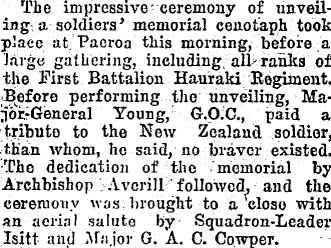
Paeroa Memorial is quite impressive on top of Primrose Hill it has a magnificent view of the surrounding countryside.  The Memorial is of a cenotaph style.  There are no names inscribed on the memorial.   I would be interested to know if those who gave their lives from Paeroa in WW1 is recorded elsewhere.  The Memorial is in need of some tender loving care especially a repaint.  I especially admired the green painted wreath on the memorial.

Waihi War Memorial and War Memorial Church - 22 April 2011


The Waihi War Memorial is situated in the Waihi Cemetery is is a lovely peaceful spot and the site is fairly well maintained.  There are no names on the Memorial but in the Waihi township their is a lovely arched entranceway to the Church which records the names of those who lost their lives in WW1. 

Hikutaia Memorial - 22 April 2011


Hikutaia is a quaint memorial on State Highway 26, between Thames and Paeroa.  It lists both those who gave their lives and those who served.   The memorial is in the form of gates to Alley Memorial Park.  Several members of the Alley family served in WW1.

Wednesday, April 20, 2011

Stephen Alexander Bell - Howick Memorial revisited


Private Stephen Alexander Bell was born on the 19 January 1891 the son of Alexander and Helen T. Letharn Bell, farmers from Pakuranga.  Private Bell left on his 'great adventure' with the Main Body on the 16 October 1914 and disembarked in Egypt on the 14 December 1914.  

When I intially looked at Private Bell's military service record there was very little said about his service, just the usual dates, medical history and personal details.  I almost passed him by and then I thought why shouldn't I mentioned him here in this blog he was one of many ordinary fellows who went off to World War One who didn't return and whose name is now etched in stone on a memorial. I wish I had space and time to mention all those who gave their lives.   All deserve our attention especially as we approached Anzac Day.

Private Stephen Alexander Bell was killed in action on the 8 May 1915 at Gallipoli he is remembered at the Redoubt Cemetery, Helles, Turkey where 1,393 of the burials are unidentified but special memorials commemorate 349 casualties known or believed to be buried among them Private Bell has a special memorial.  (information from CWGC)

My first piece of publicity

 Below is a link to my first piece of publicity for the project.  I am hoping this will help me to reach a wider audience.  If anyone does have any interesting stories from the memorials I visit I would love you to share them with me.

Thanks Central Leader

http://www.stuff.co.nz/auckland/local-news/central-leader/4909433/Wartime-tales-of-loss-and-love#share

Tuesday, April 19, 2011

Sergeant Wilfred Campbell Rimmer - Mt Eden Memorial re-visited


Wilfred Rimmer was born in Auckland the eldest son of Mr. and Mrs. S. L. P. Rimmer of Fairview Road, Mount Eden.  He was a member of the Mount Eden hockey Club and was involved with the YMCA.

Before enlisting on 21 August 1914 he worked as a coffee roaster for his father who was a coffee merchant in Wellesley Street.   Wifred embarked with the Main Body on the 16 October 1914 headed for Gallipoli. 

He distinguished himself together with two others at Lone Pine between the 6th - 8th August 1915 and was awarded the Military Medal as reported in the London Gazette on the 11th October 1916:

While 1st Battery was in action on Russell's Top between 6th and 8th August 1915 during the action of "Lone Pine" these three men although slightly wounded on as many as three of four occasions, refused to leave their gun in what was a most critical period of the operations. Although their emplacement received direct hits and was demolished on several occasions, they set to work under fire in order to remove debris and succeeded each time in getting their gun into action again.

Unfortunately such bravery did not give a soldier a ticket to survive the war.  Wilfred Rimmer was sadly killed in action at the Somme on the 17 September 1916 aged 24 years.  He is buried at Thistle Dump Cemetery, High Wood, Longueval.


Anzac Day - 25 April 2011

On Thursday I set off for the Bay of Plenty to hopefully record a further nine memorials.  On Anzac Day I will attend the Waihi Beach Dawn Parade (fingers crossed for a dry morning). 

Thomas Grey Culling - Remuera Memorial


Thomas Grey Culling was born in Dunedin in 1896, he was the only son of Thomas and Fanny Culling.   His father had previously been the Mayor of St Kilda, Dunedin before the family moved to Auckland where Thomas attended Kings College in Auckland. 

He was commissioned to the Royal Naval Air Service in January 1916 and after training in England  with only 59 flying hours under his belt he was accepted for overseas service.  He takes the honour of being the first New Zealand WW1 ace with six credited victories.  He was awarded the DSO in April 1917 - citation below:

Citation for Distinguished Service Order (DSO): "In recognition of his services on 23rd April 1917, when with two other machines he engaged a formation of nine hostile scouts and two-seater machines. Two two-seater machines were shot down, one of them by Flt Lieut. Culling unassisted." (London Gazette, issue no. 30147 published on 22 June 1917, p. 6256)

Sadly he did not live long enough to receive his honour is person.  Thomas was shot down on the 8th June 1917 and was one of the first New Zealand casualties in the air, he was 21 years old and is remembered on the Arras Flying Services Memorial which commemorates nearly 1,000 airmen with no known grave.  An account of his victories can be found at the link below:


Article image 

Friday, April 15, 2011

A war memorial in Vietnam


Came across this memorial while on my cycling trip through North Vietnam.  It is a memorial to the Vietnam/American War.  This is the only one I have come across, although there are lots of small military cemeteries dotted across the country.

Saturday, April 2, 2011

All quiet on the blogging front...

I am about to board a plane for Vietnam and a two week holiday so the blog will be quieter than usual.  Once back at Easter I am going to visit the Bay of Plenty and hope to visit the following memorials:
Paeroa, Te Aroha, Katikati, Mt Manganui, Tauranga, Waihi, Te Puke, Omahu and Hikutaia.  It will be a busy May researching the memorials but I am really looking forward to spreading my wings further across New Zealand.

Frederick William Lucas - Pukekohe Memorial


My Great Grandfather fought in World War One his name was Frederick William Lucas so you can imagine how I felt when I looked at the names on the Pukekohe Memorial and saw a F. W. Lucas.  I was even more surprised when on further research I discovered he had the exact same name as my Great Grandfather.

Frederick William Lucas was born on the 27 March 1885, he had already served in the military during the Boer War with the 10th Contingent.  He was keen to serve again  enlisting on the 27 October 1914 and embarked with the 2nd Reinforcements on the 14 December 1914 headed for Gallipoli.  He was killed in action on the 8 August 1915. 

My Great Grandfather luckily survived the war and I continue to research his war.  The sight of his name on the Pukekohe Memorial was without a doubt an emotional moment.  I would love to know more about the Frederick William Lucas from Pukekohe maybe one day I will.

Wednesday, March 30, 2011

Pukekohe World War One Memorial - 21 March 2011


The Pukekohe memorial was place outside the War Memorial Hall in Pukekohe in 1980.  It was originally unveiled on the 6 November 1921 by Prime Minister William Massey. For more information check out the link below
http://www.nzhistory.net.nz/media/photos/pukekohe-first-world-war-memorial

I found in Papers Past a report of the stirring speech given my Prime Minister William Massey at the time of the unveiling which I have reproduced.


The emotions of writing my blog

Today I was asked if I get emotional when researching the stories of the men and women on the Memorials who have died in such tragic circumstances, the answer is I do.

Often their stories are so moving that it is hard not to be emotional.  Most died so young they had not  begun to live their life or fulfilled their dreams and therefore often there is very little to write.

I like to think my blog brings those who perished in WW1 back to life for a moment (if only in a small way) and also help to remind us that they were ordinary people like you and I.

Private Reginald McDivitt - Pukekohe Memorial


Private Reginald McDivitt embarked on the 17 April 1915 with the 4th Reinforcements, Auckland Infantry Battalion.  He served at Gallipoli before moving on to the Western Front where  he was awarded the Military Medal for devotion to duty below is the report from the London Gazette dated the 16 August 1917 on how he won his medal:

"Messines Offensive - 7th to 9th June 1917. For devotion to duty. As linesman of the signallers he went out during the heaviest bombardments to repair the lines. He worked continuously and by sticking to his work enabled communication to be kept. He worked regardless of his own safety."

He was sadly killed in action only weeks later on the 25 July 1917 and is buried at Mud Corner Cemetery, Comines-Warneton, Hainaut, Belgium.  Reginald McDivitt was the eldest son of William McDivitt of Pukekohe.  His brother Frank McDivitt a well known Jockey at the time also served on the Western Front and survived the war.